Nifty 50 And Sensex October Performance Over The Past Decade: A Look At Market Gains, Losses And Changing Trends
 Add Preferred News Source
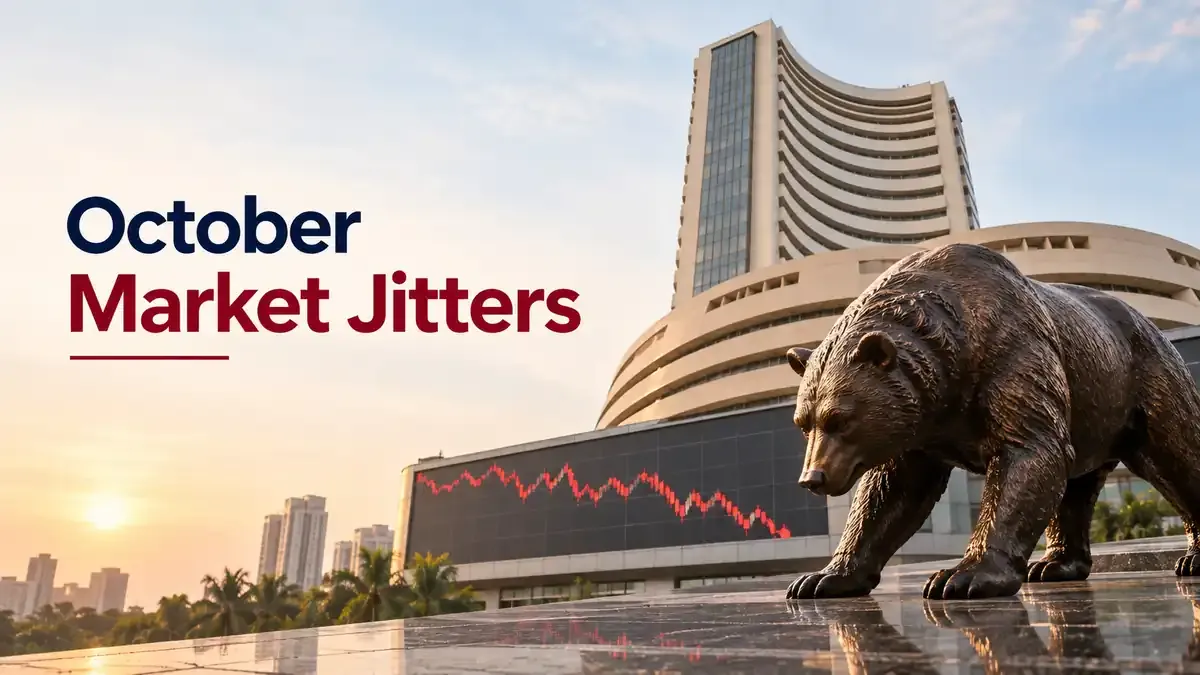
The Indian stock market entered October 2026 after an eight-week losing streak in the Nifty 50 and Sensex. This is the longest such run in 25 years. October also carries a strong historical association with major global market crashes.
The Indian stock market began October 2026 on a cautious note after the Nifty 50 and Sensex recorded their eighth consecutive weekly decline. The streak was the longest for both indices in 25 years.
The September sell-off was particularly sharp, with the Nifty falling nearly 6% and losing more than 1,400 points during the series.
Foreign investor selling added to the pressure. Foreign institutional investors (FIIs) ended a two-month buying streak in September and sold heavily in Indian equities. Foreign outflows from Indian equities had crossed ₹2.5 lakh crore in 2026, based on National Securities Depository Limited (NSDL) data.
October’s History With Major Global Market Crashes
At the same time, October’s reputation among global investors has been shaped by major crashes.
The Black Monday stock market crash took place on 19 October 1987. The Dow Jones Industrial Average fell nearly 22% in a single session, marking the biggest single-day percentage decline in US stock market history. The fall was reported to have wiped out nearly $500 billion in market capitalisation in the US alone.
The Wall Street crash of 1929 also unfolded in October. The Dow Jones Industrial Average dropped nearly 13% on 28 October, followed by a decline of almost 12% the following day. These sessions became known as Black Monday and Black Tuesday, respectively.
Another major sell-off was in October 2008 when the US stock market crashed at the peak of the Global Financial Crisis. The economic downturn after the collapse of the US housing market and defaults on subprime mortgages triggered the crisis.
Nifty 50 And Sensex Show Mixed October Performance
The Nifty 50 and Sensex have experienced a mixed performance during October over the past decade. The data below covers the October performance of both indices from 2016 through 2025.
Year | Nifty 50 | Sensex |
|---|---|---|
2016 | 0.20% | 0.23% |
2017 | 5.59% | 6.17% |
2018 | -5.00% | -4.93% |
2019 | 3.50% | 3.78% |
2020 | 3.50% | 4.06% |
2021 | 0.30% | 0.31% |
2022 | 5.37% | 5.78% |
2023 | -2.84% | -2.97% |
2024 | -6.22% | -5.83% |
2025 | 4.51% | 4.57% |
October performance has varied widely over the past decade. Both benchmarks gained in some years and declined in others. They generally moved in the same direction, although the size of their monthly moves differed.
The sharpest weakness came in 2024, after a decline a year earlier. Both benchmarks returned to positive territory in the following October. Overall, October has not shown a consistent upward or downward trend for Indian equities.
Global Cues And Earnings Could Shape October Market Recovery
US bond yields above 5%, a firm dollar, elevated crude prices and a weaker rupee have increased pressure on Indian equities. Higher US yields can attract global investors to dollar assets. But costly crude oil could raise India's import bill and inflation, as well as current account pressures.
Festival demand, government spending and the beginning of the earnings season could support large banks, select manufacturers and domestic consumption stocks. However, these factors alone may not be sufficient to bring foreign capital back.
At least two of the factors among FII flows, global bond yields and the rupee would need to improve for a meaningful and sustained recovery. The domestic liquidity could provide some downside cushioning.
The second-quarter earnings season is another key test. Investors would closely track revenue growth, margins and management commentary. Crude prices, geopolitical developments and weak monsoon conditions in some states could also influence sentiment. Festive demand may support fast-moving consumer goods (FMCG) and automobile companies, although its durability will depend on the strength of demand.
Also Read - Bajaj Finance Plans ₹17,500 Crore Fundraise Through QIP, Promoter Warrants, First Equity Raise Since 2023
This article is for informational purposes only and should not be considered investment advice from Kotak Neo. For compliance T&C and disclaimers, Visit www.kotakneo.com/disclaimer

Vishwa has spent 10+ years across fintech and FMCG doing what most people miss, connecting the dots, catching trends before they trend, and finding the angle nobody else thought to ask about.
At Kotak Neo, she drives content strategy for neoshorts, Kotak News Desk, and Investing Guide, turning market noise into something worth reading.
When she's not decoding markets, she trades charts for canvases, chasing art, painting, and architecture across cities she's yet to explore.
Right Tools, Rich Insights