 Add Preferred News Source
1,001 Views| 24 Oct 2026
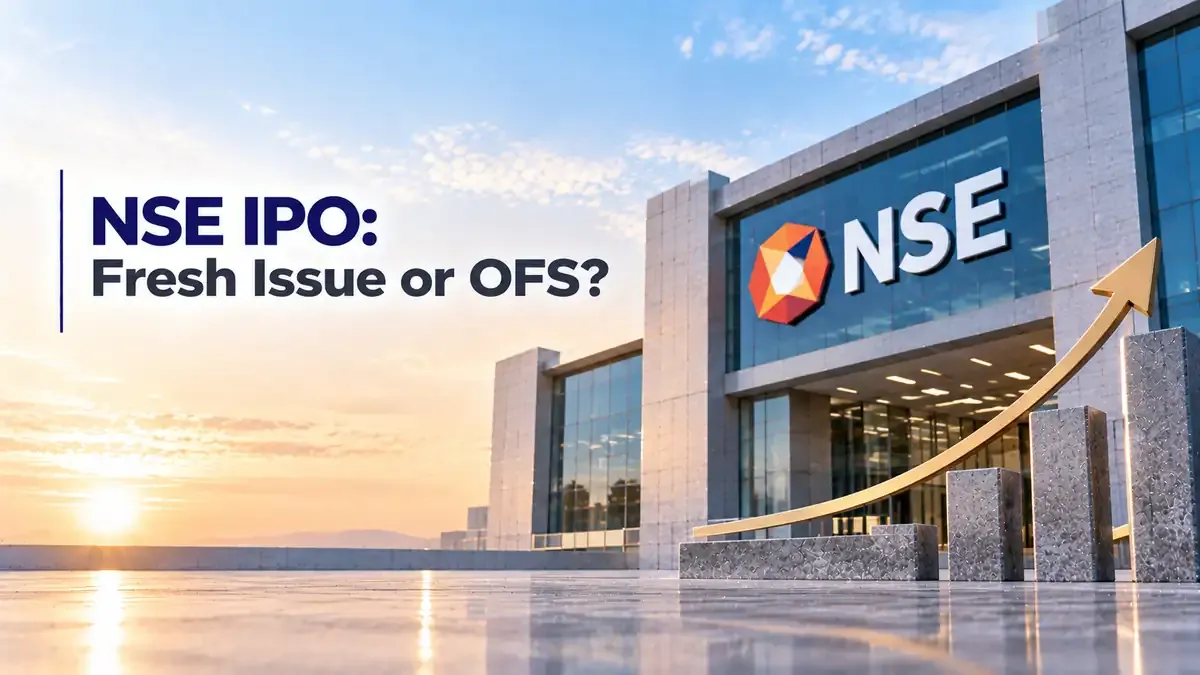
NSE IPO: Is It a Fresh Issue or OFS? Rs 30,000-Crore Issue Explained
Summary
NSE’s proposed Rs 30,000-crore IPO will be entirely an offer for sale, meaning existing shareholders will sell their stakes while the exchange itself will not receive the proceeds.
The National Stock Exchange (NSE) is finally getting closer to its long-awaited stock market debut. The proposed IPO could be worth around Rs 30,000 crore, which would put it among the biggest public issues India has seen. But there is an important detail behind that headline figure: NSE is not raising fresh capital through the offering.
The IPO is structured entirely as an Offer for Sale (OFS). Existing shareholders will sell part of their holdings to public investors, while NSE will not issue new shares as part of the offer. As a result, the money paid by investors will go to the shareholders selling their shares, rather than to the exchange.
Since there is no fresh issue, NSE will not receive IPO proceeds for expansion, technology investments, debt repayment or other corporate purposes. So, even if the final issue size is close to Rs 30,000 crore, the exchange itself will not receive those funds.
How will the NSE IPO work?
NSE's draft red herring prospectus, filed with SEBI and BSE on June 17, 2026, proposed an OFS of up to 14.89 crore equity shares. The shares on offer represent nearly 6% of NSE's paid-up capital, with around 10 institutional shareholders expected to sell their holdings.
The proposed sellers include State Bank of India, Canada Pension Plan Investment Board, Bank of Baroda, New India Assurance and United India Insurance Company. LIC, however, is not selling shares in the proposed IPO.
For NSE, the main benefit of the listing is that its shares will have a publicly traded price and valuation. Existing shareholders will also have a market through which they can sell their holdings.
The distinction between an OFS and a fresh issue is important here. In a fresh issue, new shares are created and the company receives the money raised. In an OFS, existing shares change hands and the proceeds go to the shareholders who are selling.
How big could the NSE IPO be?
The NSE IPO could be valued at around Rs 5.2 lakh crore to Rs 5.3 lakh crore, while the price band could potentially be set in the Rs 2,100-Rs 2,300 range. The final valuation, issue size and price band will be decided closer to the launch.
The listing process has gained momentum after SEBI approved the IPO on September 4. The approval came after the Supreme Court disposed of the regulator's pending appeals relating to the NSE co-location and dark fibre cases.
NSE has also begun its pre-IPO roadshow, with meetings with institutional investors across financial centres including Boston, New York, San Francisco, London, Singapore and Hong Kong. Reports suggest the price band could be announced around September 11, with the listing targeted before September 25, although these timelines remain subject to change.
At around Rs 30,000 crore, the NSE IPO would be larger than Hyundai Motor India's Rs 27,859-crore issue in 2024 and LIC's Rs 20,557-crore IPO in 2022.
For investors, therefore, the NSE IPO is primarily a public listing and stake-sale exercise rather than a fund-raising exercise for the exchange itself. The final issue size and price will determine whether it ultimately becomes India's largest IPO by issue value.
Also Read - Coal Gasification Scheme: Adani Enterprises, NTPC Among Applicants for Rs 37,500-Crore Programme
This article is for informational purposes only and should not be considered investment advice from Kotak Neo. For compliance T&C and disclaimers, Visit www.kotakneo.com/disclaimer
About the Author
Rochelle Britto
Rochelle Britto has spent 8+ years decoding India's markets, businesses, and consumer economy, reporting for ET Prime and Times Internet along the way, covering the stories behind the numbers.
A Mumbai native and perpetual planner of the next holiday, she stays far, far away from the eternal question, “Where are we going next?” When she's not chasing headlines, she's chasing new cultures, open roads, and a bit of quiet in nature.
Right Tools, Rich Insights

Latest News
- 1,052 Views| 24 Oct 2026
- 1,088 Views| 24 Oct 2026
- 1,080 Views| 24 Oct 2026
- 1,010 Views| 24 Oct 2026
- 1,031 Views| 23 Oct 2026
- 1,044 Views| 23 Oct 2026
- 1,053 Views| 23 Oct 2026
- 1,043 Views| 23 Oct 2026
- 1,025 Views| 23 Oct 2026