Add Preferred News Source

1,033 Views| 27 Oct 2026
Brazil's Market Fell 14% In One Session While South Korea's KOSPI Dropped 42%: Here Is What Indian Investors Should Know
Summary
Brazil's stock market dropped after unexpected election results. South Korea’s KOSPI plummeted in a sell-off driven by AI. Here is how these events compare with India's market risks.
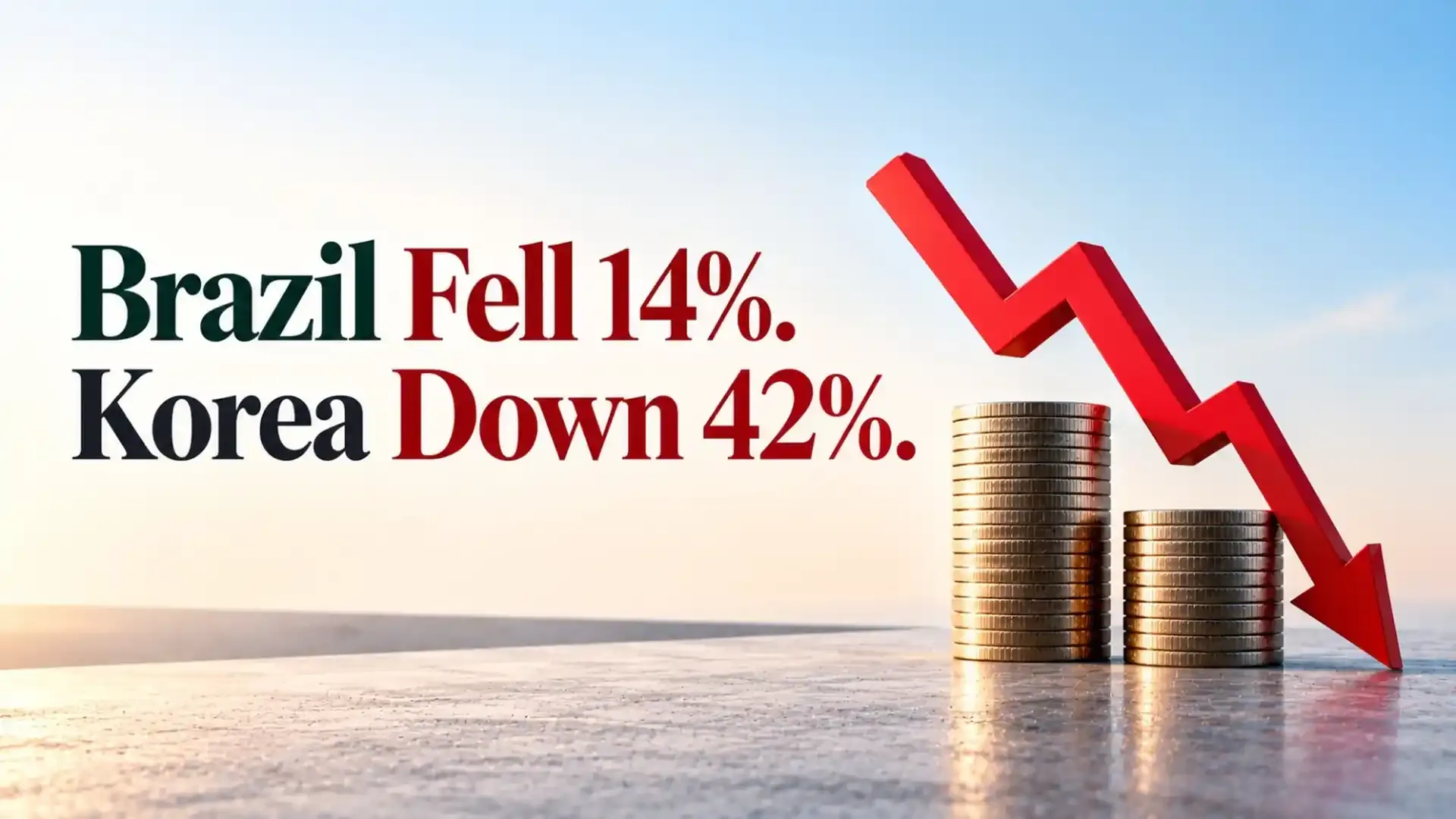
A stock market can look strong one day and take a sharp hit the next. Brazil saw its benchmark index plunge around 14% in a single session after an unexpected election result. South Korea's KOSPI has fallen about 42% from its peak. The reasons are different, but these recent global market news show how quickly things can turn when investors bet heavily on one outcome or focus on a small group of stocks.
Why Did Brazil And South Korea's Stock Markets Fall?
Many investors had expected Flávio Bolsonaro to win Brazil's presidential election. There were hopes around tighter government spending and policies they believed would be more favourable to markets. Luiz Inácio Lula da Silva's victory caught them off guard. The result triggered a sell-off in Brazilian stocks and weakened the Brazilian Real against the US Dollar. Worries about government spending and debt added to the pressure.
South Korea's story is different. The KOSPI had rallied strongly on the back of the AI boom, with Samsung Electronics and SK Hynix driving much of the gains. Together, the two chipmakers account for a large share of the index. Investors eventually began questioning how long the AI-driven growth could last. This led to pressure on these stocks. The fall was worsened by heavy selling and leveraged bets.
Can Indian Stock Market Face Similar Risks?
Indian indices moved higher on 26 October 2026. This shows that today global market movements do not always affect every country in the same way. The Sensex gained 483 points, or 0.66%. The Nifty 50 also rose 0.68%. But that does not mean India is free from risks. The market has seen stocks tumble when election results have not gone as expected. So any doubt over that can impact market sentiment in India as well, as it did in Brazil.
South Korea's market fall is a reminder that investors need to look at where they put their money. India has a wider mix of companies across its benchmark indices, but that does not mean every investor is protected. If most of your money is in a few stocks or one sector, a fall in that part of the market can hurt your portfolio.
India has other things to watch out for as well. The country imports a large amount of crude oil. So when oil prices shoot up, the impact can be felt here too. India ends up paying more for imports. This can eventually put pressure on the rupee and push inflation higher. Foreign investors have also been pulling money out of Indian stocks. Rising US bond yields, a stronger dollar and changing global investment trends have all played a part.
Why Does Diversification Matter?
Holding several Indian stocks may not be enough if they all depend on the same sector or economic factors. Investing across countries and sectors can spread that exposure, though it cannot prevent losses. Global markets can fall together, and overseas investments bring currency and political risks of their own. The point is not to guess which country will crash next. It is to avoid letting one market, sector or investment idea decide the fate of an entire portfolio.
This article is for informational purposes only and should not be considered investment advice from Kotak Neo. For compliance T&C and disclaimers, Visit www.kotakneo.com/disclaimer
About the Author

Vishwa Ved
Vishwa has spent 10+ years across fintech and FMCG doing what most people miss, connecting the dots, catching trends before they trend, and finding the angle nobody else thought to ask about.
At Kotak Neo, she drives content strategy for neoshorts, Kotak News Desk, and Investing Guide, turning market noise into something worth reading.
When she's not decoding markets, she trades charts for canvases, chasing art, painting, and architecture across cities she's yet to explore.
Right Tools, Rich Insights

Latest News
- 1,074 Views| 27 Oct 2026
- 1,002 Views| 27 Oct 2026
- 1,000 Views| 27 Oct 2026
- 1,095 Views| 27 Oct 2026
- Transformers And Rectifiers (TARIL) Shares Rally As Company Announces ₹1,250 Crore Gujarat Expansion
 1,020 Views| 27 Oct 2026
- 1,015 Views| 27 Oct 2026
- 1,018 Views| 27 Oct 2026
- 1,066 Views| 27 Oct 2026
- 1,036 Views| 27 Oct 2026