 Add Preferred News Source
1,006 Views| 23 Oct 2026
US Imposes 10% Tariff On Indian Goods Under Forced Labour Action
Summary
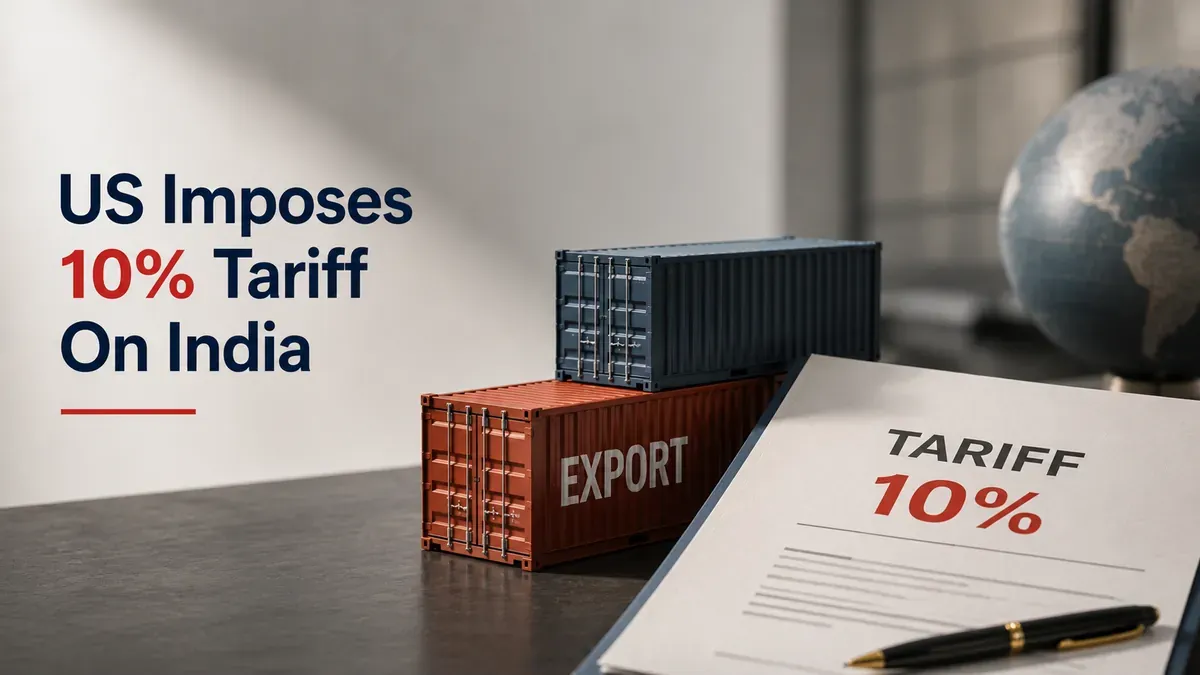
The US imposed 10% tariffs on Indian goods under a forced labour trade action covering 60 economies, reducing India's rate from the proposed 12.5% after New Delhi amended its foreign trade policy in June.
The United States (US) imposed a 10% tariff on goods imported from India under Section 301 of the Trade Act of 1974 from 12.01 AM on Friday as part of a wider action covering 60 economies over the use of forced labour in production.
US Trade Representative Jamieson Greer announced the tariffs a day before a temporary 10% levy on all countries was due to expire.
India's rate of 10% is lower than the 12.5% that had been proposed earlier. Washington took note of India's amendment to its foreign trade policy on 14 June, which introduced a prohibition on importing goods produced using forced labour.
The Federal Note accompanying the announcement specifically cited that policy change as the reason for placing India in the lower tariff bracket.
How The 60-Country Action Breaks Down
-
17 countries including India, Canada, the United Kingdom, Bangladesh and Pakistan: 10% tariff
-
Remaining 43 countries: 12.5% tariff
-
Countries without laws barring forced labour goods such as China, the United Kingdom and Japan: 12.5% tariff
-
Exemptions: Raw materials that would cause domestic supply shortages, products causing economy-wide disruption and goods that cannot be produced in sufficient quantities in the United States
The Legal And Political Context
The tariff action follows the US Supreme Court's February ruling that struck down the president's earlier Liberation Day tariffs introduced in April 2025 and the reciprocal tariffs imposed using emergency powers.
The Trump administration responded by imposing 10% tariffs on all countries as a temporary measure, which expired on Friday. The Section 301 forced labour action replaces that blanket levy with a targeted framework.
India has contested both USTR investigations and maintained that the issues can be addressed within the bilateral trade agreement currently under negotiation. The US is India's second-largest trade partner and the single largest destination for Indian exports. Bilateral goods trade in 2025 stood at approximately $141 billion, with Indian exports valued at $87.3 billion.
What The Rate Reduction Signals
The step down from 12.5% to 10% is being read as a calibrated signal rather than a resolution. Analysts said it suggests Washington is willing to acknowledge policy progress while maintaining pressure on enforcement, preserving the strategic trajectory of the India-US economic relationship without fully removing the tariff burden.
Also Read - Motilal Oswal Q1 FY27 Results: PAT At ₹1,273 Crore, Stock Drops Over 7% In Early Trade
This article is for informational purposes only and should not be considered investment advice from Kotak Neo. For compliance T&C and disclaimers, Visit www.kotakneo.com/disclaimer
Right Tools, Rich Insights

Latest News
- 1,053 Views| 23 Oct 2026
- Paras Healthcare IPO Allotment Status: Check Online on MUFG Intime India, NSE & BSE for Live Updates
 1,074 Views| 23 Oct 2026
 - 1,059 Views| 23 Oct 2026
- 1,032 Views| 23 Oct 2026
- Tata Teleservices Q2 Results: Loss Narrows Sharply, But Shares Crash 11% After Earnings Announcement
 1,038 Views| 23 Oct 2026
 - 1,098 Views| 23 Oct 2026
- 1,037 Views| 23 Oct 2026
- 1,068 Views| 23 Oct 2026
- 1,005 Views| 23 Oct 2026