Jindal Stainless To Raise Coin Blank Capacity By 20% To 12,000 Tonnes
 Add Preferred News Source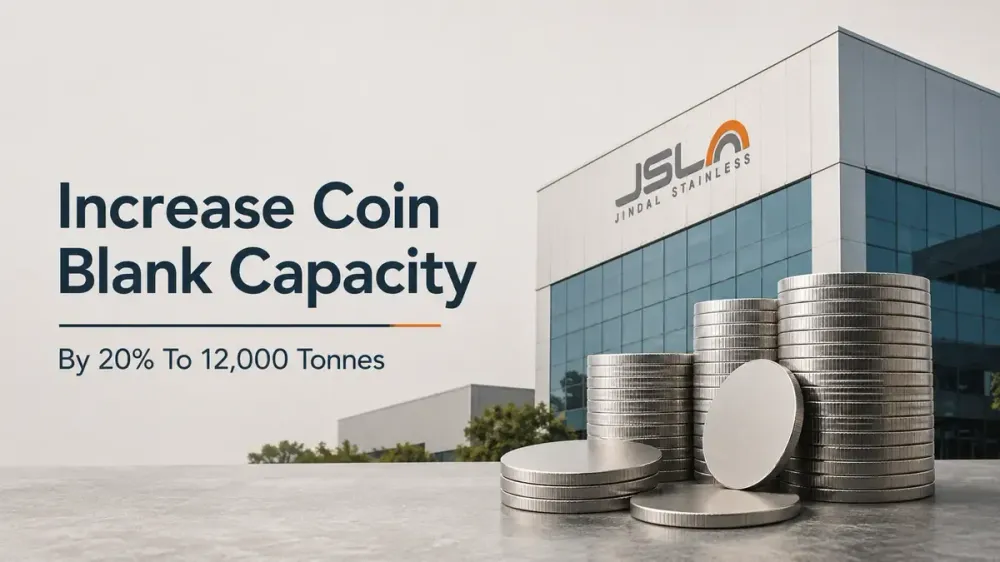
Jindal Stainless plans to raise its annual coin blank capacity to 12,000 tonnes from 10,000 tonnes, as it expects demand for non-paper currency to rise across geographies. The company supplies unstamped coin blanks to mints in India, France, Finland, Poland, the Netherlands, the UK, Malaysia and Slovakia.
Jindal Stainless is increasing its coin blank-making capacity by 20% as it looks to cater to higher demand across international markets. The company's Special Products Division (SPD) at Hisar currently has a capacity of 10,000 tonnes a year, which will be raised to 12,000 tonnes.
The company expects further orders, including for denominations it does not currently manufacture, according to Vijay Bindlish, Unit Head of the Jindal Stainless Hisar facility.
Why Is Jindal Stainless Increasing Coin Blank Capacity?
Jindal Stainless makes coin blanks for the Indian as well as international mints. The blanks are produced at its SPD facility in Hisar under high-security arrangements. The division also manufactures products such as razor blades and precision strips.
The company supplies unstamped coin blanks to mints in India, France, Finland, Poland, the Netherlands, the UK, Malaysia and Slovakia. Each order is made to specifications provided by the respective mint.
These specifications cover the size, diameter, thickness, shape and alloy composition of the coin blanks.
The company expects demand to rise partly due to the lower carbon footprint associated with its stainless steel manufacturing. Jindal Stainless is also looking for orders covering denominations that it does not currently make and plans to enter new markets.
The company will therefore raise its annual coin blank capacity from 10,000 tonnes to 12,000 tonnes.
What Else Does Jindal Stainless Make At Its Hisar Facility?
The Hisar SPD handles several specialised products besides coin blanks. Saurabh Kumar, head of the division, said its razor blade capacity has increased to 19,500 tonnes a year from 13,200 tonnes.
The razor blades are supplied to markets including India, Poland, Vietnam, China and South Korea. The company intends to maintain its market position in this business.
The Hisar facility has an annual capacity of 0.8 million tonnes (MT). It began carbon steel production in 1970 and moved to stainless steel manufacturing in 1978, with the shift aimed at reducing import dependence.
The facility's operations also include measures to manage water use and energy consumption. Sushil Jain, head of the cold rolling division, said the plant operates a zero liquid discharge system. Processed water and acids are recovered, treated and reused within the facility, with zero industrial effluent.
How Is The Hisar Plant Changing Its Energy Mix?
Jindal Stainless plans to increase the share of green energy used at the Hisar plant to 80% this year from 70%.
The increase will be supported by two captive hydrogen projects and a floating solar project, according to Jain.
The expansion comes alongside the wider activity at the Hisar facility, where specialised products such as razor blades and precision strips are also manufactured.
Also Read - Bombay HC Questions Maharashtra FDA's Enforcement Approach
This article is for informational purposes only and should not be considered investment advice from Kotak Neo. For compliance T&C and disclaimers, Visit www.kotakneo.com/disclaimer

Vishwa has spent 10+ years across fintech and FMCG doing what most people miss, connecting the dots, catching trends before they trend, and finding the angle nobody else thought to ask about.
At Kotak Neo, she drives content strategy for neoshorts, Kotak News Desk, and Investing Guide, turning market noise into something worth reading.
When she's not decoding markets, she trades charts for canvases, chasing art, painting, and architecture across cities she's yet to explore.
Right Tools, Rich Insights