FMCG Stocks Face $5.2 Billion FII Selloff Over 12 Months
 Add Preferred News Source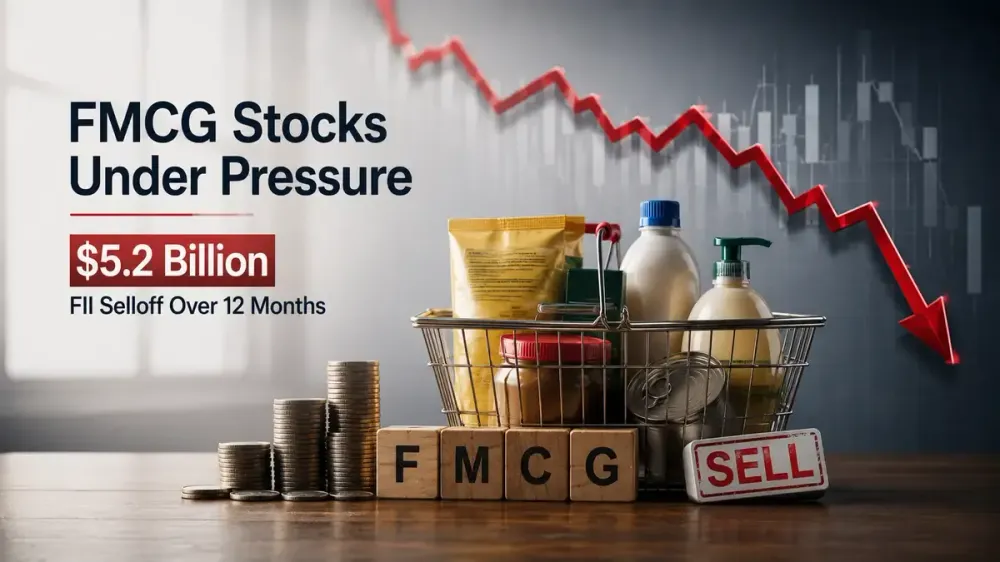
Foreign institutional investors have pulled $5.25 billion out of FMCG stocks over the past 12 consecutive months, even as they turned net buyers of Indian equities overall in July. Analysts point to stretched valuations, input cost pressures and slowing volume growth as key reasons behind the persistent selling. Read ahead to know more.
Foreign institutional investors (FIIs) have remained persistent sellers of fast-moving consumer goods (FMCG) stocks for twelve consecutive months, with cumulative outflows from the sector reaching $5.25 billion, even as overall foreign flows into Indian equities turned positive in July.
Since the September 2024 market peak, FIIs have withdrawn a cumulative $57 billion from Indian markets, including around $27 billion so far in CY26, though July saw inflows of $2.5 billion, the strongest monthly figure in 13 months.
FMCG, however, continued to see outflows throughout the year, with July alone recording an outflow of ₹1,103 crore, taking the total CY26 figure to ₹28,276 crore, according to NSDL data.
Stock Performance Reflects Sustained Selling Pressure
The impact of sustained foreign selling has been evident in share price performance across the sector. Hindustan Unilever has declined 18% over the past year, while ITC has fallen 34% and Dabur is down 20%. Tata Consumer has slipped 9% this year, though Nestle and Britannia have bucked the trend, rising 35% and 4%, respectively.
What Is Driving The FII Exit
According to analysts, FMCG has traditionally served as a defensive allocation for foreign investors, but with growth in the sector remaining in single digits and valuations elevated, any slowdown in growth tends to trigger a de-rating of high multiples.
Experts also flagged the near-term impact of deficient monsoons as an additional concern. While the underlying quality of FMCG businesses is not being questioned, according to experts, the debate has increasingly shifted to how much investors are willing to pay given uncertain near-term earnings growth.
Analysts also pointed to stretched valuations, raw material inflation, gross margin pressure, sluggish rural recovery, urban down-trading, market share losses to quick commerce players and broader rotation into value and commodity stocks as reasons behind the continued selling.
However, some experts noted that consumer staples are currently trading at a roughly 8% discount to their ten-year average forward earnings multiple, weakening the argument that valuations alone explain the exodus.
Outlook For FY27 Remains Cautious
While the June quarter earnings season came in better than expected on both revenue and margins, according to analysts, much of the margin improvement has been attributed to inventory gains that could fade from the September quarter onwards if crude oil prices stay elevated.
Experts said companies are likely to respond through calibrated price hikes, premiumisation and cost efficiencies, though there remains a limit to how much inflation can be passed on before it affects consumption in mass-market categories.
Some experts believe the pressure need not be extrapolated too aggressively, noting that easing geopolitical tensions and normalising commodity prices could support a relatively quick recovery in margins, with the festive season expected to serve as a key test of consumer demand resilience.
Signals To Watch For A Reversal
According to experts, a durable rebound in FII interest would likely require a meaningful pickup in rural and urban consumption, moderation in input costs, and an attractive valuation entry point backed by genuine earnings upgrades. Some market participants remain sceptical of the sector at current valuations, cautioning that elevated price-to-earnings multiples could cap returns even if companies continue to post strong results.
Others noted that the seven-month streak of foreign selling should not be read as a sign of a broader breakdown in Indian staples consumption, pointing out that leading companies have still delivered healthy volumes in the June quarter.
Analysts believe the sector's next decisive trigger will come from earnings, with stabilising input costs and resilient volume growth expected to drive upward revisions in FY27 and FY28 earnings estimates.
Also Read - Muthoot Fincorp Appoints Four Lead Managers For ₹3,000 Crore IPO
This article is for informational purposes only and should not be considered investment advice from Kotak Neo. For compliance T&C and disclaimers, Visit www.kotakneo.com/disclaimer

Vishwa has spent 10+ years across fintech and FMCG doing what most people miss, connecting the dots, catching trends before they trend, and finding the angle nobody else thought to ask about.
At Kotak Neo, she drives content strategy for neoshorts, Kotak News Desk, and Investing Guide, turning market noise into something worth reading.
When she's not decoding markets, she trades charts for canvases, chasing art, painting, and architecture across cities she's yet to explore.
Right Tools, Rich Insights