 Add Preferred News Source

4 Min. Read• 1,028 Views
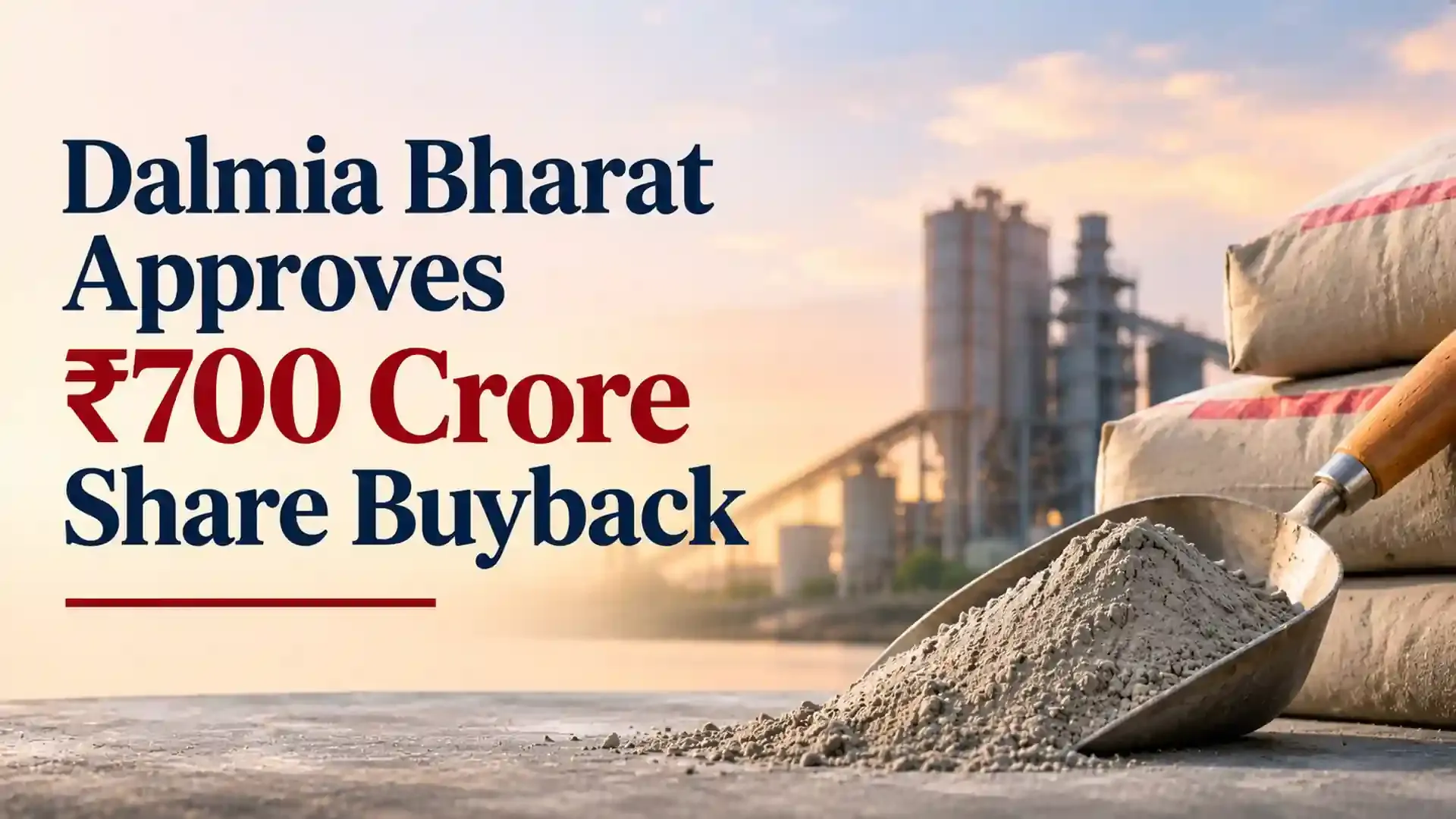
Dalmia Bharat Board Approves Share Buyback Of ₹700 Crore At ₹1,850 Per Share; To Buy Back Up To 37.83 Lakh Shares
Summary
Dalmia Bharat has approved a share buyback of up to ₹700 crore at a maximum price of ₹1,850 per share. The open market buyback will be for a maximum of 37.83 lakh shares excluding participation by the promoters. The buyback will begin on or before 2 December 2026, the company added.
Dalmia Bharat has approved a share buyback of up to ₹700 crore at a maximum price of ₹1,850 a share. The cement maker will buy back its shares through the open-market route on the Bombay Stock Exchange (BSE) and the National Stock Exchange (NSE).
The board approved the proposal at its meeting on 23 November 2026. The buyback will cover up to 37,83,783 fully paid-up equity shares of ₹2 each, constituting around 2.02% of its existing paid-up equity share capital.
The company published its public announcement on 26 November, outlining the proposed schedule and other details of the buyback.
Dalmia Bharat Buyback Size and Share Repurchase Details
Dalmia Bharat has committed to utilising at least 75% of the maximum buyback size, amounting to ₹525 crore, for the share repurchase. It will also have to deploy at least ₹280 crore, or 40% of the maximum buyback amount, during the first half of the 66 working days from the opening date.
The final number of shares purchased will depend on the average price at which the company acquires them. If the shares are bought below ₹1,850, it may be able to repurchase more shares within the approved amount.
Eligibility of Shareholders and Open-Market Buyback Route
Under the open-market mechanism, the company will place buy orders with its broker on the stock exchanges and buy shares at prevailing market prices, subject to the price not exceeding ₹1,850 per share.
Unlike a tender offer, in which a company invites eligible shareholders to sell their shares at a set price, an open-market buyback does not guarantee shareholders that they will be able to sell at the maximum buyback price.
The buyback will be open to eligible shareholders and beneficial owners. However, promoters, members of the promoter group and persons in control of the company have been excluded from participating.
Shareholders should not assume that there will be a fixed tender-offer entitlement or acceptance ratio.
Dalmia Bharat Buyback Timeline and Important Dates
According to the public announcement, the buyback is scheduled to open on or before 2 December 2026 and will continue for up to 66 working days.
The company has also formed a buyback committee to oversee the process and appointed Rajeev Kumar, its company secretary and compliance officer, as the compliance officer for the buyback.
Buyback Price is a Premium Over Market Price
The maximum buyback price of ₹1,850 was a premium of about 19.3% to Dalmia Bharat’s share price of ₹1,550.95 on the BSE in the afternoon of 23 November, when the board approved the proposal.
Dalmia Bharat shares closed at ₹1,492 on 27 November, down 2.78% or ₹42.70 from the previous close of ₹1,534.70. The stock opened at ₹1,535.90 and touched an intraday high of ₹1,544.70 and a low of ₹1,480.30. It has declined 5.46% over the past week and 30.16% year-to-date, compared with a 0.58% weekly decline and a 0.17% year-to-date gain in the Nifty 500.
What the Buyback Means for Dalmia Bharat Shareholders
A share buyback allows a company to return a portion of its surplus capital to shareholders by purchasing its shares. It can also reduce the number of outstanding shares, depending on the number ultimately repurchased.
For shareholders, the main points to monitor are the buyback opening date, the prices at which the company buys back shares, and the total amount used. The ₹1,850 cap is the highest price the company can pay, not a guaranteed exit price for investors, as purchases will depend on market conditions.
Sources
SEBI
This article is for informational purposes only and should not be considered investment advice from Kotak Neo. For compliance T&C and disclaimers, Visit www.kotakneo.com/disclaimer
About the Author
Vishwa Ved
Vishwa has spent 10+ years across fintech and FMCG doing what most people miss, connecting the dots, catching trends before they trend, and finding the angle nobody else thought to ask about.
At Kotak Neo, she drives content strategy for neoshorts, Kotak News Desk, and Investing Guide, turning market noise into something worth reading.
When she's not decoding markets, she trades charts for canvases, chasing art, painting, and architecture across cities she's yet to explore.
Right Tools, Rich Insights

Latest News
- 4 Min. Read• 1,066 Views
- 3 Min. Read• 1,036 Views
- 2 Min. Read• 1,059 Views
- 2 Min. Read• 1,085 Views
- 4 min read• 1,056 Views
- 2.5 Min. Read• 1,081 Views
- 4 Min. Read• 1,070 Views
- 3.5 Min. Read• 1,025 Views
- 2 Min. Read• 1,042 Views