Government Assigns LPG Production Targets to 21 Firms; Reliance Gets Biggest Share
 Add Preferred News Source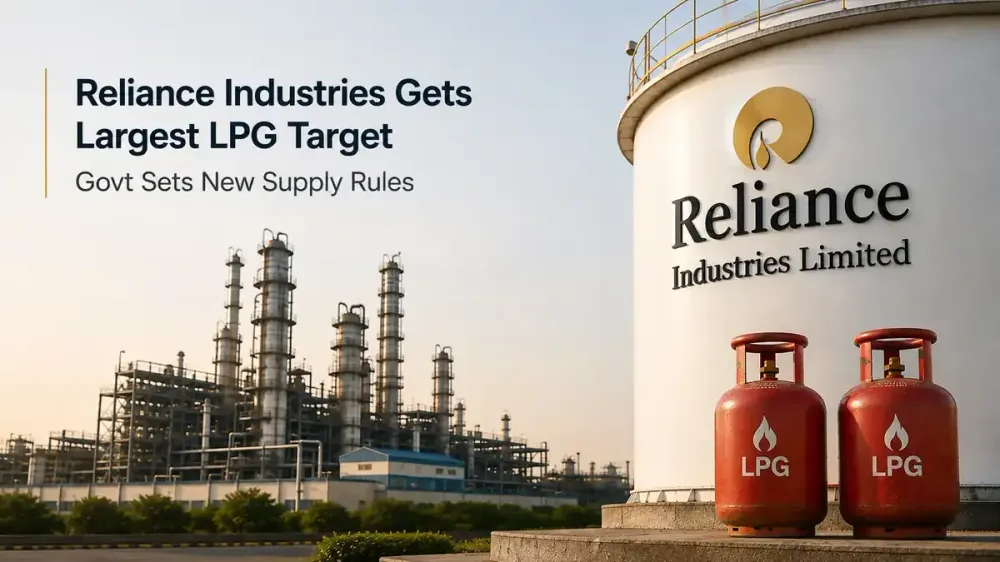
The government has set facility-specific maximum LPG production targets for 21 refineries and upstream companies, with total production capacity fixed at 63,810 tonnes a day. Reliance Industries' Jamnagar DTA refinery has the largest target at 18,000 tonnes a day as India seeks a domestic supply buffer after the West Asia crisis.
The government has introduced a standing framework for liquefied petroleum gas (LPG) production after the West Asia conflict exposed India's dependence on imported cooking gas. An order issued by the Petroleum and Natural Gas Ministry on 13 August sets maximum production levels for 21 refineries and upstream companies.
The combined maximum production capacity under the schedule is 63,810 tonnes a day, more than twice India's domestic LPG output in FY26 and around 70% of daily consumption. Reliance Industries Ltd's older Jamnagar refinery has received the largest allocation at 18,000 tonnes a day.
Why Has The Government Set New LPG Production Targets?
The new limits will apply when the government sees a supply constraint. The framework also requires public-sector, joint-venture and private-sector oil refining companies along with upstream oil companies to maintain infrastructure for LPG storage, evacuation and transportation.
The move follows the supply disruption during the West Asia conflict. India consumed 33.2 million tonnes of LPG in FY26, or around 91,000 tonnes a day. Domestic production stood at 13.1 million tonnes, while imports accounted for 21.3 million tonnes.
That meant more than 64% of India's LPG requirement was met through imports. The disruption to the Strait of Hormuz, through which India received around 90% of its imports from countries such as Saudi Arabia, brought this dependence into focus.
During the crisis, the government asked refineries to divert streams used for petrochemical production towards LPG. Domestic output rose to around 55,000 tonnes a day at the peak of the disruption. Those emergency measures were gradually withdrawn after supplies improved from mid-June.
The new order puts facility-level production requirements in place beyond the temporary measures used during the crisis.
How Much LPG Will Reliance And Other Companies Produce?
Reliance Industries Ltd's 33 million tonnes a year domestic tariff area refinery at Jamnagar in Gujarat has been assigned a maximum LPG production target of 18,000 tonnes a day. The company's 35.2 million tonnes a year export-only refinery at the same site has not been given a target.
The allocation across other producers includes:
- Public sector refineries: 18 refineries have been assigned a combined target of 31,470 tonnes a day.
- Nayara Energy: Its 20 million tonnes a year Vadinar refinery has a target of 4,480 tonnes a day.
- Upstream companies: Producers and processors such as ONGC and GAIL have been assigned 6,460 tonnes a day.
The order also requires companies to assess technically and economically feasible ways to raise LPG output. These include converting naphtha into LPG and upgrading fluid catalytic cracking units.
What Powers Will The Government Have Under The New Framework?
The government can direct oil refining companies, oil marketing companies and upstream oil companies to increase LPG production by a specified quantity for a specified period when it considers such action necessary.
The directions can also include restrictions on the alternative use of input streams needed to produce LPG. Companies will have to increase production within the time specified in the order.
The framework goes beyond production volumes. Companies must maintain adequate arrangements for storing, evacuating and transporting LPG, either directly or via railways and road tankers.
The production schedule will also be reviewed twice a year. The government will update it on 1 January and 1 July to account for new refineries, upstream companies and additional output created through changes in infrastructure, production technology, evacuation, supply, transport or distribution.
The framework is therefore designed to remain adjustable as production capacity changes.
Also Read - Indian Bank Plans To Raise $400 Million Through ECBs This Week; May Raise Another $600 Million
This article is for informational purposes only and should not be considered investment advice from Kotak Neo. For compliance T&C and disclaimers, Visit www.kotakneo.com/disclaimer

Vishwa has spent 10+ years across fintech and FMCG doing what most people miss, connecting the dots, catching trends before they trend, and finding the angle nobody else thought to ask about.
At Kotak Neo, she drives content strategy for neoshorts, Kotak News Desk, and Investing Guide, turning market noise into something worth reading.
When she's not decoding markets, she trades charts for canvases, chasing art, painting, and architecture across cities she's yet to explore.
Right Tools, Rich Insights