 Add Preferred News Source

2 Min. Read• 1,070 Views
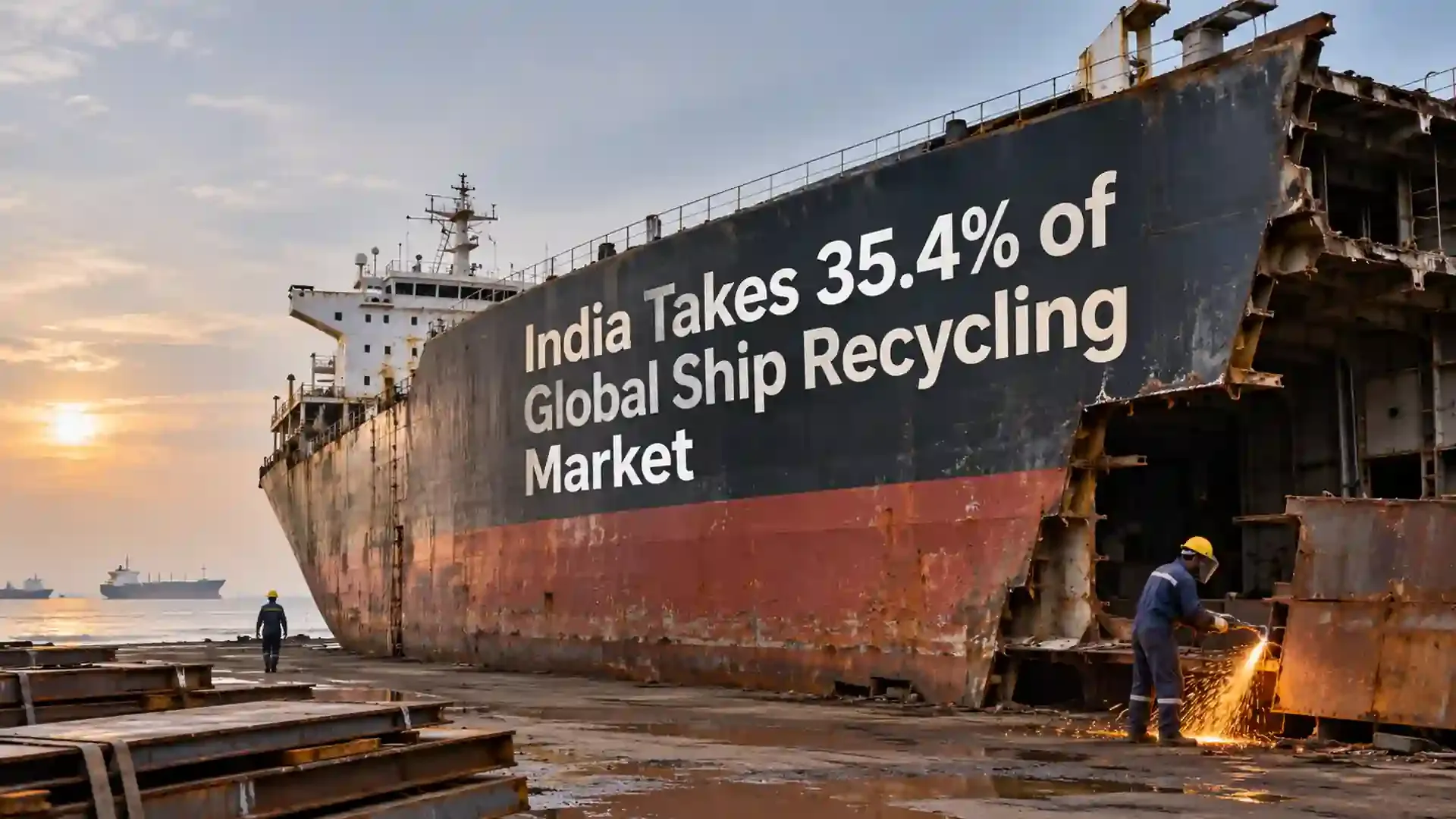
India Takes 35.4% of Global Ship Recycling Market as Ageing Fleet Offers Fresh Growth Opportunity
Summary
India's share of global ship-recycling rose to 35.4% in 2025, overtaking Bangladesh. UNCTAD stated further opportunities as ageing vessels approach retirement.
India's share of the global ship-recycling market reached 35.4% in 2025. A year earlier, Bangladesh had led the market with 43.2%, compared with India's 33.9%.
More ships could head to recycling yards in the coming years. According to the United Nations Conference on Trade and Development (UNCTAD), nearly 42% of vessels worldwide are over 20 years old.
India Overtakes Bangladesh in Global Ship Recycling Market
In 2024, Bangladesh led the ship-recycling market with a 43.2% share, while India stood at 33.9%. A year later, India moved ahead with 35.4%, leaving Bangladesh at 32.3%.
Recycling activity at Indian yards also increased. Around three million gross tonnes of ships were dismantled in 2025, against 2.15 million gross tonnes a year earlier.
Much of the activity involved dismantling tankers and gas carriers.
A further increase in recycling activity could follow as more ships approach the end of their operating lives. However, owners must first decide whether replacing an ageing vessel makes better financial sense than keeping it in service.
How Have Maritime Disruptions Affected India's Shipping Industry?
Several major shipping routes experienced disruptions simultaneously in 2026. This affected the vessel movements across international waters.
UNCTAD's 2026 report, Shipping at a Crossroads, found that traffic through the Strait of Hormuz had fallen by almost 95% by early March. Even towards the end of July, there had been little recovery.
Under normal conditions, the passage carries 37% of crude oil shipped worldwide by sea. Problems along the Red Sea, Black Sea and Panama Canal added to the pressure on shipping networks.
Some vessels diverted from troubled routes reached Indian ports. Whether this temporary movement will bring lasting gains for India's maritime sector remains unclear.
India also slipped in the global ranking of shipowning nations. The latest UNCTAD figures put the country in 20th place, compared with 17th a year earlier.
Indian shipowners controlled 1,178 vessels with a total capacity of 28.8 million deadweight tonnes (dwt). Their share of global capacity stood at 1.1%, down from 1.5% when the fleet comprised 1,244 vessels.
Of the tonnage owned by Indian companies, 37.3% operated under foreign flags.
The Indian shipping registry, however, held on to its 20th position. Registered tonnage rose by 6%. UNCTAD said the Merchant Shipping Act, 2025, could support further growth by easing vessel ownership requirements.
To deal with future disruptions, the UN agency has recommended advance planning between countries sharing important shipping corridors. The aim is to have alternative arrangements ready before another major route becomes inaccessible.
What Could Limit India's Ship Recycling Growth?
An older global fleet does not necessarily mean more ships will immediately arrive at recycling yards.
Nayeem Noor, Vice-President of Business Development at GMS, said recycling volumes had remained lower than the industry expected during much of 2026.
Shipowners have continued operating older vessels because freight earnings remain healthy. Strong prices in the second-hand vessel market have also made selling ships for further use an attractive option.
India faces another challenge in securing approval for its recycling facilities from European authorities.
The European Parliament recently voted against adding two Alang shipbreaking yards to the European Union's approved list. The decision has complicated efforts to establish wider recognition of Indian facilities under the Hong Kong Convention's environmental and safety standards.
A final decision is still pending. EU member states must vote on the proposal before the European Commission completes the process.
Noor pointed out that recycling facilities located within the EU accounted for only around 2% of global recycling volumes between 2018 and 2026, measured in light displacement tonnage.
European-owned ships sailing under non-EU flags can still be dismantled at Alang, provided the applicable rules are followed.
For Indian recyclers, the bigger factor will be when shipowners begin retiring vessels in greater numbers. That decision will depend heavily on freight earnings, second-hand ship prices and the cost of keeping older ships operational.
Also Read - BPCL Approves ₹1,26,656 Crore Refinery and Petrochemical Project in Andhra Pradesh, Targets July 2032
This article is for informational purposes only and should not be considered investment advice from Kotak Neo. For compliance T&C and disclaimers, Visit www.kotakneo.com/disclaimer
About the Author

Vishwa Ved
Vishwa has spent 10+ years across fintech and FMCG doing what most people miss, connecting the dots, catching trends before they trend, and finding the angle nobody else thought to ask about.
At Kotak Neo, she drives content strategy for neoshorts, Kotak News Desk, and Investing Guide, turning market noise into something worth reading.
When she's not decoding markets, she trades charts for canvases, chasing art, painting, and architecture across cities she's yet to explore.
Right Tools, Rich Insights

Latest News
- 2 Min. Read• 1,081 Views
- 2 Min. Read• 1,049 Views
- 2.5 Min. Read• 1,028 Views
- 2 Min. Read• 1,009 Views
- 2 Min. Read• 1,017 Views
- 2.5 Min. Read• 1,047 Views
- 2 Min. Read• 1,001 Views
- 2.5 Min. Read• 1,058 Views
- 2.5 Min. Read• 1,077 Views