Add Preferred News Source
1,010 Views| 27 Oct 2026
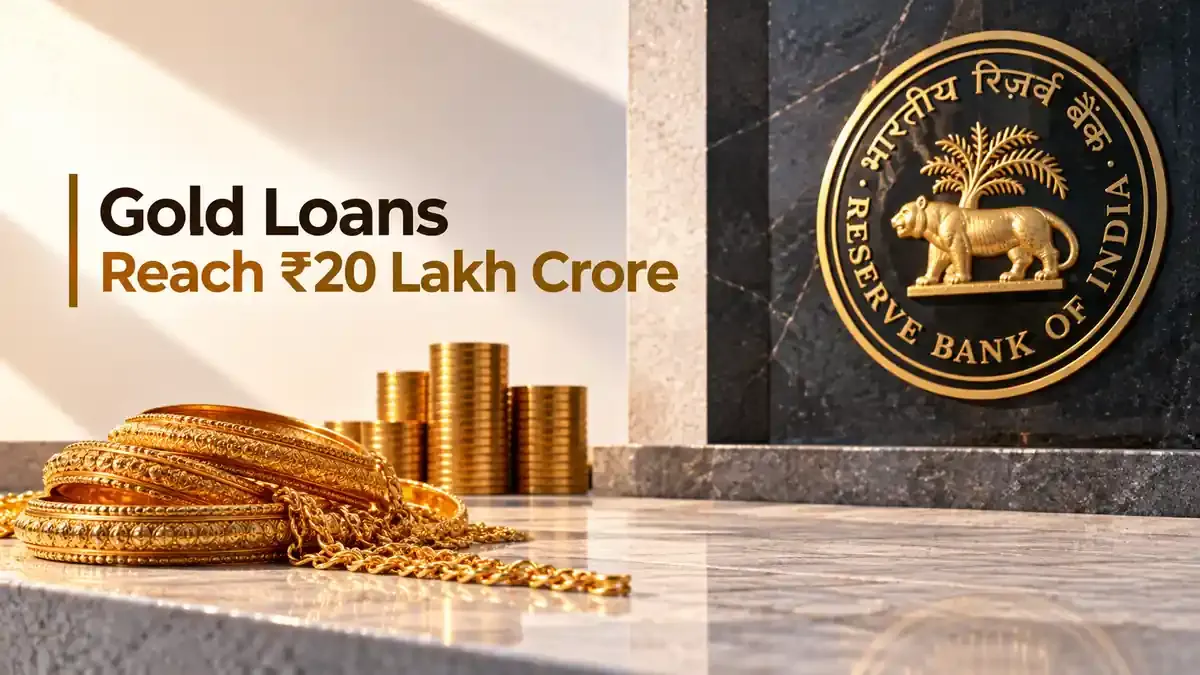
Gold Loans Reach ₹20 Lakh Crore But RBI Sees No Signs Of Overheating
Summary
Gold loans have grown rapidly as higher gold prices lifted borrowing capacity, while repeat borrowing and top-up loans remain key risks to monitor.
India's gold-loan market has expanded sharply, with outstanding loans across banks and non-banking financial companies (NBFCs) now estimated at around ₹20 lakh crore. Despite the rapid growth, Reserve Bank of India (RBI) Governor Sanjay Malhotra said the central bank does not currently see signs of overheating in the segment, citing low loan-to-value (LTV) levels and improving asset quality.
Speaking to CNBC-TV18, Malhotra said the RBI remains watchful as gold-backed lending continues to grow. NBFCs account for around ₹4 lakh crore of the overall gold-loan book, while gold loans as a whole remain a single-digit share of total credit.
The sharp increase in gold prices has been an important factor behind the expansion. Since lenders determine the amount that can be advanced against pledged gold based on its value, borrowers can raise larger loans against the same quantity of gold when prices rise.
Malhotra also said the RBI's efforts to rationalise, clarify and simplify gold-loan regulations have supported the segment. However, he noted that the central bank has not carried out a study to determine the precise contribution of each factor to the industry's growth.
The organised gold-loan market has grown several times over in recent years. Motilal Oswal Financial Services estimates that the segment reached ₹18.6 lakh crore in March 2026, nearly four times its size five years earlier. The brokerage estimates growth of 50% year-on-year in FY26, helped by gold prices rising more than 60% and increased demand for loans for consumption and business requirements.
The RBI's assessment is also supported by the quality of the loan book. Malhotra said gross non-performing assets (NPAs) for gold loans are below 1%, at around 0.4–0.5%, and have improved for both banks and NBFCs over the past year.
The regulatory framework also leaves lenders with a buffer against a decline in gold prices. Depending on the loan category, RBI rules allow LTV levels of between 75% and 85%. Average industry LTVs are estimated to be lower, at around 55% for banks and 60% for NBFCs, according to Motilal Oswal.
This provides some protection if gold prices correct. Malhotra illustrated that a loan issued at a 75% LTV against gold valued at 100 would remain covered if the value fell to 67. Even after a 50% decline in gold prices, the loss in that example would be limited to around 13%.
However, the rapid growth in gold loans does not mean all risks have disappeared. One area flagged by Motilal Oswal is the increasing contribution of repeat borrowers and top-up loans to new originations.
Existing-to-asset borrowers accounted for 82% of gold-loan originations in 2025, compared with 76% in 2022, according to the brokerage. Existing-to-gold-loan borrowers accounted for 90% of originations.
The trend suggests that a substantial part of the industry's expansion is coming from customers who already have gold loans and are borrowing again or increasing their existing exposure. This could create an overleveraging risk if the pattern continues, even though current asset-quality indicators remain comfortable.
Motilal Oswal has also observed that gold tonnage and customer numbers at Muthoot Finance and Manappuram Finance have remained broadly stagnant even as their loan books have grown. The brokerage therefore sees higher gold valuations and repeat borrowing as important factors behind the increase in outstanding loans.
For now, the RBI's position is that the pace of growth warrants close monitoring but does not, based on current LTV and asset-quality indicators, point to an immediate systemic concern.
Also Read - Paytm Shares Hit 52 Week High As Stock Gains 4% On Bernstein Bullish Call
This article is for informational purposes only and should not be considered investment advice from Kotak Neo. For compliance T&C and disclaimers, Visit www.kotakneo.com/disclaimer
About the Author

Rochelle Britto
Rochelle Britto has spent 8+ years decoding India's markets, businesses, and consumer economy, reporting for ET Prime and Times Internet along the way, covering the stories behind the numbers.
A Mumbai native and perpetual planner of the next holiday, she stays far, far away from the eternal question, “Where are we going next?” When she's not chasing headlines, she's chasing new cultures, open roads, and a bit of quiet in nature.
Right Tools, Rich Insights

Latest News
- 1,039 Views| 27 Oct 2026
- 1,041 Views| 27 Oct 2026
- 1,004 Views| 27 Oct 2026
- 1,045 Views| 27 Oct 2026
- 1,097 Views| 27 Oct 2026
- 1,054 Views| 27 Oct 2026
- 1,065 Views| 27 Oct 2026
- 1,001 Views| 27 Oct 2026
- 1,022 Views| 27 Oct 2026