Add Preferred News Source
1,061 Views| 05 Nov 2026
Buying Gold This Dhanteras 2026? Check New BIS Hallmarking Charges, Purity Rules And Compensation
Summary
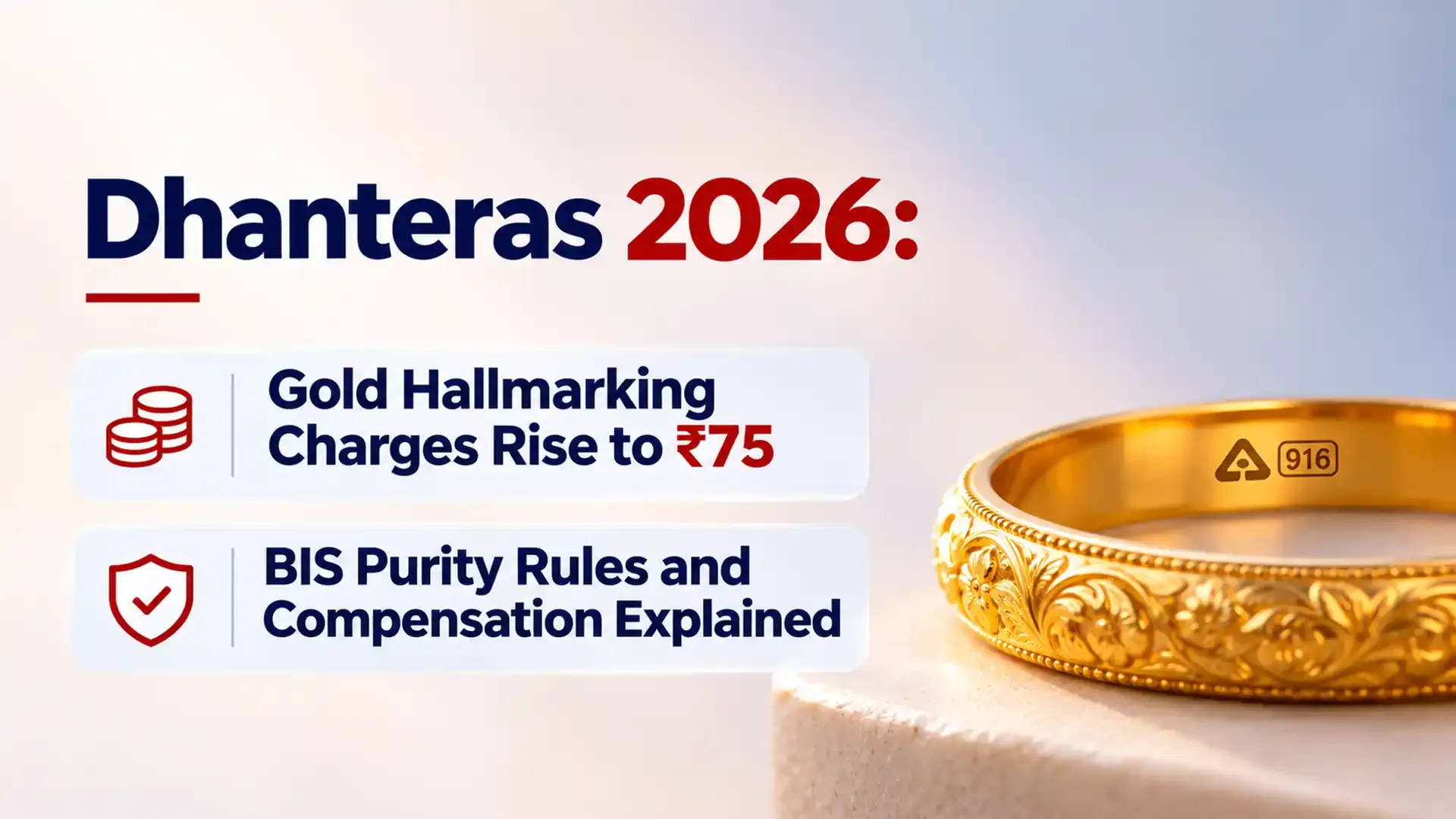
Gold buyers have a few changes to note ahead of Dhanteras 2026. BIS has raised hallmarking charges for gold articles from ₹45 to ₹75, while the fee for silver remains unchanged. Buyers can also seek compensation if hallmarked jewellery is found to be less pure than the grade marked on it.
Gold buyers heading to jewellery stores this Dhanteras may notice a change in hallmarking charges. The Bureau of Indian Standards (BIS) has increased the fee for hallmarking gold articles from ₹45 to ₹75 per piece, a rise of nearly 67%. The new rates came into effect in September 2026.
Dhanteras falls on November 6 this year, when many families buy gold jewellery, coins and other valuables. While gold rates and making charges usually get most of the attention, buyers also need to check the purity of the jewellery and the charges included in the bill.
The revised hallmarking fee is paid by jewellers to BIS-recognised centres. It is not a compulsory separate charge of ₹75 on every customer. Another important rule allows buyers to seek compensation if hallmarked jewellery fails a purity test.
Under BIS rules, compensation for a purity shortfall can be twice the value of the difference, along with the testing charges.
Gold Hallmarking Charges 2026: What Has Changed?
The BIS (Hallmarking) Amendment Regulations, 2026, revised the charges for gold articles in September.
Jewellers now pay ₹75 per gold article to recognised Assaying and Hallmarking Centres, compared with ₹45 earlier. The minimum charge for a consignment is ₹200.
For silver articles, the hallmarking fee has been kept at ₹35 per piece, with a minimum of ₹150 per consignment.
Hallmarking centres test jewellery to check whether its gold content matches the stated purity. The revised fee applies to this service and is paid by jewellers.
For someone buying a gold chain or ring, the final cost will depend mainly on the day's gold rate, the weight of the ornament, making charges and GST. Any other charges added by the jeweller should be shown clearly on the bill.
Making charges can vary from one store to another, even for jewellery of the same weight and purity. Buyers comparing prices should therefore look at the total amount rather than only the gold rate quoted by the store.
The purity mark also matters. A 22-carat gold ornament carries the 916 mark, meaning it contains 91.6% gold. Similarly, 18-carat jewellery is marked 750, indicating 75% gold content.
A BIS-hallmarked gold article should carry the BIS logo, the purity mark and a six-character Hallmark Unique Identification (HUID) number.
The HUID number can be checked through the BIS Care mobile app. Buyers can open the 'Verify HUID' option, enter the number printed on the jewellery and check the details shown. The details should match the ornament being purchased, including its type and purity.
What If Hallmarked Gold Jewellery Fails A Purity Test?
A hallmark gives buyers information about the purity of their jewellery. But if a buyer later finds that the gold content is lower than the grade marked on the ornament, BIS rules provide a way to claim compensation.
Under Rule 49 of the BIS Rules, 2018, compensation for hallmarked jewellery found to be of lower purity is calculated at twice the value of the purity shortfall, along with testing charges.
For instance, if testing shows that the value of the purity shortfall in an ornament is ₹2,000, the compensation would be ₹4,000, apart from the cost of testing.
This does not mean buyers receive twice the price of the jewellery. The calculation is based on the difference between the purity promised and the purity found during testing, taking the weight of the article into account.
A buyer who suspects a problem can take the jewellery to a BIS-recognised Assaying and Hallmarking Centre. The centre tests the article for a fee and issues an assay report.
If the report shows that the jewellery is less pure than the hallmark indicates, the buyer can approach the jeweller or register a complaint with BIS.
Complaints can be filed through the BIS Care app, the BIS website or by contacting the regulator's complaint office. BIS examines the complaint before deciding on compensation under the rules.
The compensation provision has been in place since 2018. It is separate from the hallmarking fee revision announced in September this year.
Buyers should also keep the invoice given by the jeweller. The bill should show the weight and purity of the jewellery, the gold rate used for the purchase, making charges and applicable taxes.
For jewellery containing stones, buyers should check whether the stone weight has been separated from the gold weight while calculating the price.
The invoice and purity test report can be useful if a complaint has to be filed later.
With Dhanteras approaching, buyers comparing jewellery prices should check the HUID number, the purity marked on the ornament and the charges mentioned on the bill before paying. The BIS compensation rule also gives customers a way to raise a dispute if the gold they bought does not match the promised purity.
This article is for informational purposes only and should not be considered investment advice from Kotak Neo. For compliance T&C and disclaimers, Visit www.kotakneo.com/disclaimer
About the Author

Anindya Banerjee
Anindya Banerjee Head of Research - Commodities, Currencies & Interest Rate Derivatives at Kotak Neo.
Anindya Banerjee is a market veteran with over two decades of experience in trading and analyzing global financial markets, spanning currencies, commodities, and interest rate derivatives. As Head of Research at Kotak Neo, he leads one of India’s most dynamic FICC research teams, integrating macroeconomics, geo-economics, and data-driven analytics to generate actionable insights for institutional and corporate clients. Anindya’s work bridges the worlds of global macro strategy and quantitative analysis - blending fundamentals, technicals, and market microstructure intelligence to decode price behavior across asset classes.
He has been a strong advocate for integrating technology and AI in market research, risk management, and trading decision frameworks. A recognized thought leader in India’s financial markets, Anindya frequently shares his views on currency and commodity markets across leading media platforms and industry forums. His research aims to simplify complex market narratives and translate them into strategic perspectives that help market participants make informed decisions in an increasingly multipolar and data-driven global economy.
Right Tools, Rich Insights

Latest News
- 1,018 Views| 05 Nov 2026
- 1,059 Views| 05 Nov 2026
- 1,009 Views| 05 Nov 2026
- 1,030 Views| 05 Nov 2026
- 1,069 Views| 05 Nov 2026
- 1,091 Views| 05 Nov 2026
- 1,045 Views| 05 Nov 2026
- 1,036 Views| 05 Nov 2026
- 1,010 Views| 05 Nov 2026