Coal Gasification Can Help Substitute Imports Worth Up to ₹3 Lakh Crore, Says Government
 Add Preferred News Source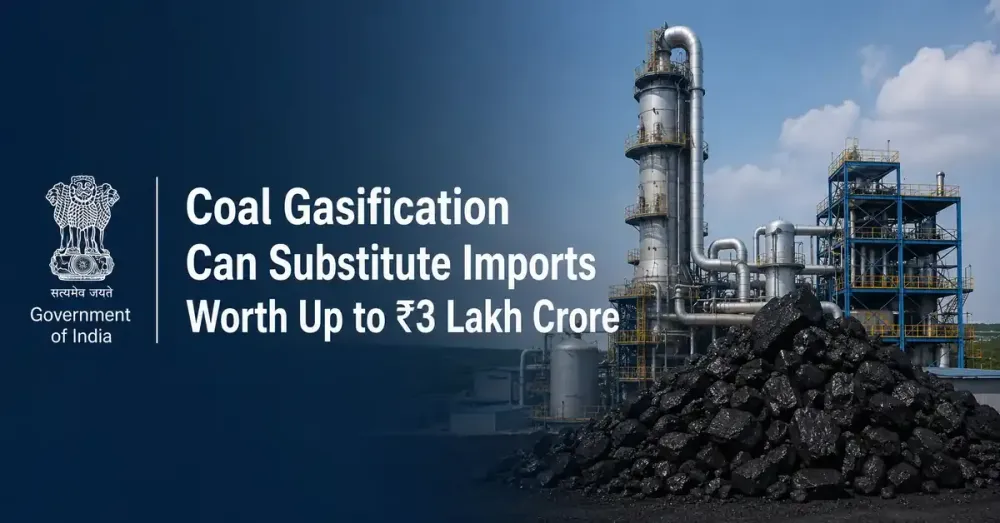
India plans to boost coal gasification to cut imports worth ₹3 lakh crore, attract investment and strengthen domestic manufacturing.
India’s push towards coal gasification could potentially replace imports worth up to ₹3 lakh crore, as the government sharpens its focus on reducing dependence on overseas fuel, fertiliser and chemical feedstocks while making better use of domestic coal reserves.
The renewed focus comes after the Union Cabinet earlier this month approved a ₹37,500 crore Scheme for Promotion of Surface Coal/Lignite Gasification Projects, one of the largest policy pushes for the sector so far. The scheme aims to accelerate India’s broader target of gasifying 100 million tonnes (MT) of coal by 2030.
Coal Gasification Seen as Key to Cutting India’s Import Dependence
Government estimates show coal gasification can support import substitution across four major categories whose combined annual import bill is nearing ₹2.77 lakh crore to ₹3 lakh crore. These include:
-
Liquefied Natural Gas (LNG): India imports more than 50% of its LNG requirement
-
Urea: Around 20% of India’s urea demand is met through imports
-
Ammonia: Nearly 100% import dependent
-
Methanol: Around 80–90% imported
Coal gasification converts coal into syngas, which is a mix of hydrogen, carbon monoxide and other gases. It can then be used to produce methanol, ammonia, synthetic natural gas, urea and petrochemical products. The government sees this as a strategic route to improve energy security while lowering exposure to volatile global commodity prices.
Under the newly approved scheme, India is targeting approximately 75 million tonnes of coal/lignite gasification capacity, with financial incentives capped at 20% of plant and machinery cost for eligible projects.
₹37,500 Crore Scheme Aims to Unlock Investment and Jobs
The ₹37,500 crore programme is also expected to unlock nearly ₹3 lakh crore in fresh investment across the coal, fertiliser, chemical and industrial manufacturing value chain.
To support long-term project viability, the government has extended the coal linkage tenure to 30 years for the “Production of Syngas leading to Coal Gasification” category. This gives developers greater fuel supply visibility and investment certainty.
India has one of the world’s largest coal reserves, estimated at around 401 billion tonnes, along with nearly 47 billion tonnes of lignite. Policymakers are positioning coal gasification as a way to extract greater economic value from these reserves beyond conventional power generation.
Industry estimates also suggest the sector could generate around 50,000 direct and indirect jobs through nearly 25 large projects, particularly across coal-bearing states such as Jharkhand, Odisha, Chhattisgarh, West Bengal and Rajasthan.
Also Read - Stock Market Update 29 May 2026: Sensex And Nifty 50 Open Slightly Higher
With geopolitical uncertainty affecting global gas and chemical supplies, coal gasification is increasingly seen by India as both an industrial strategy and an import-reduction tool, with the potential to save the country up to ₹3 lakh crore in annual imports over time while strengthening domestic manufacturing capacity.
Sources:
PIB
Reuters
The Hindu
Economic Times
This article is for informational purposes only and should not be considered investment advice from Kotak Neo. For compliance T&C and disclaimers, Visit www.kotakneo.com/disclaimer
Right Tools, Rich Insights